
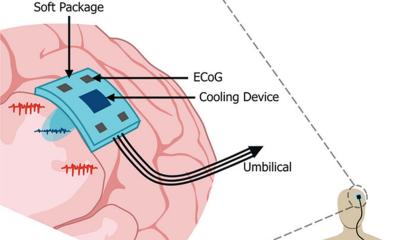
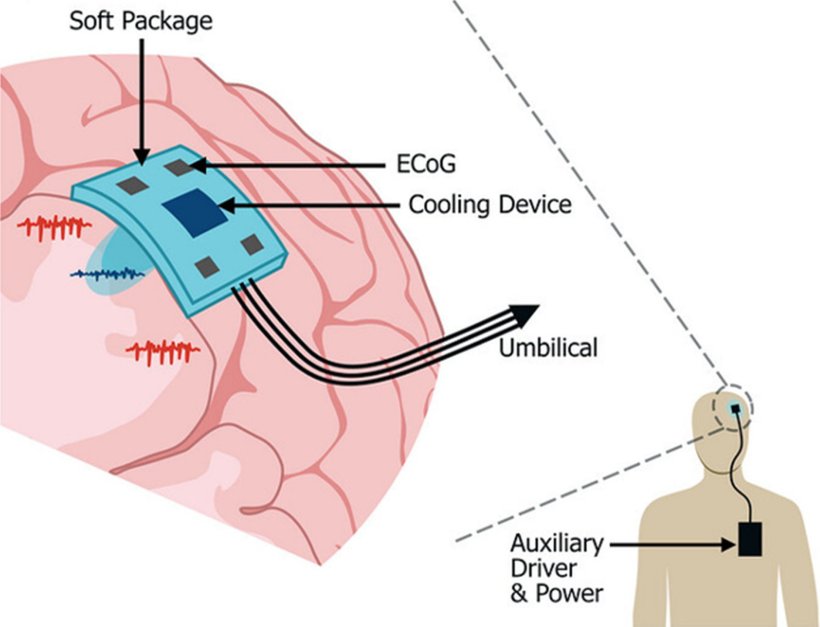
この技術は、薬剤耐性を示す焦点性てんかんの治療に代替的なアプローチの道を開く可能性がある。研究者らはAdvanced Science誌に成果を発表した。シェフィールド大学の研究者との共同研究として実施されたこの研究は、3Dプリンティング技術を用いて多機能インプラントを作成するための設計フレームワークを提示する。このフレームワークをもとに、チームは柔らかなシリコーン構造体、流体チャネル、電子部品を組み合わせて、局所的な脳冷却を行う小型インプラントを開発した。 このシステムには、インプラントの記録機能と冷却機能を自律的に監視・制御する補助駆動ユニットも含まれている。従来提案されていたシステムと比較して、この製造アプローチはインプラントの複雑さ、製造時間、デバイスサイズを低減できる可能性がある。
The researchers first validated the implant system through finite element simulations and agar-based tissue models, demonstrating rapid, stable, and localized cooling. In subsequent experiments using a rodent model of epilepsy, the implant’s 3D-printed composite electrodes produced electrocorticography (ECoG) recordings of comparable quality to those obtained with a commercial system. The team also demonstrated that focal cooling could suppress experimentally induced seizure-like activity.
設計フレームワークの実装が成功したことは、多機能で小型の医療用インプラントを開発するうえで3Dプリンティングの潜在能力を浮き彫りにし、臨床応用に向けたさらなる発展の有望な基盤を提供する。
The research was funded by the European Research Council (ERC) through the ERC Starting Grant IntegraBrain.
Source: Leibniz Institute of Polymer Research Dresden